
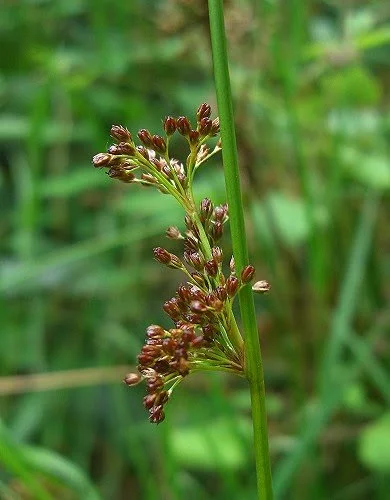
Soft rush shows up in wet ground all over Washington County, especially in ditches, low spots, stream edges, and areas that stay saturated for long periods. It’s one of the plants that naturally takes over where water limits everything else.
You’ll find it in soils that hold water consistently, from muddy low areas to the edges of standing water. It handles those conditions without issue and helps stabilize the ground where erosion or runoff is a problem.
Instead of typical leaves, it forms dense clumps of smooth, upright green stems that stay vertical through the season. It doesn’t rely on flowers for impact, but the structure stands out, especially when planted in groups.
It usually reaches a few feet tall and slowly expands outward, forming thicker patches over time. It’s not aggressive, but it will hold its ground and continue to fill in where conditions stay wet.
This is a strong choice for drainage areas, rain gardens, pond edges, and anywhere water tends to sit. It works well as a structural plant that anchors wetter sections of a planting.
Light: Full sun to part sun
Soil: Wet; tolerates saturated and poorly drained soils
Height: 3–6 ft
Bloom: Subtle, mid-summer
Wildlife: Provides cover; limited direct food value
Growth: Clump-forming rush; slowly expanding and stabilizing in wet areas
Soft rush shows up in wet ground all over Washington County, especially in ditches, low spots, stream edges, and areas that stay saturated for long periods. It’s one of the plants that naturally takes over where water limits everything else.
You’ll find it in soils that hold water consistently, from muddy low areas to the edges of standing water. It handles those conditions without issue and helps stabilize the ground where erosion or runoff is a problem.
Instead of typical leaves, it forms dense clumps of smooth, upright green stems that stay vertical through the season. It doesn’t rely on flowers for impact, but the structure stands out, especially when planted in groups.
It usually reaches a few feet tall and slowly expands outward, forming thicker patches over time. It’s not aggressive, but it will hold its ground and continue to fill in where conditions stay wet.
This is a strong choice for drainage areas, rain gardens, pond edges, and anywhere water tends to sit. It works well as a structural plant that anchors wetter sections of a planting.
Light: Full sun to part sun
Soil: Wet; tolerates saturated and poorly drained soils
Height: 3–6 ft
Bloom: Subtle, mid-summer
Wildlife: Provides cover; limited direct food value
Growth: Clump-forming rush; slowly expanding and stabilizing in wet areas