
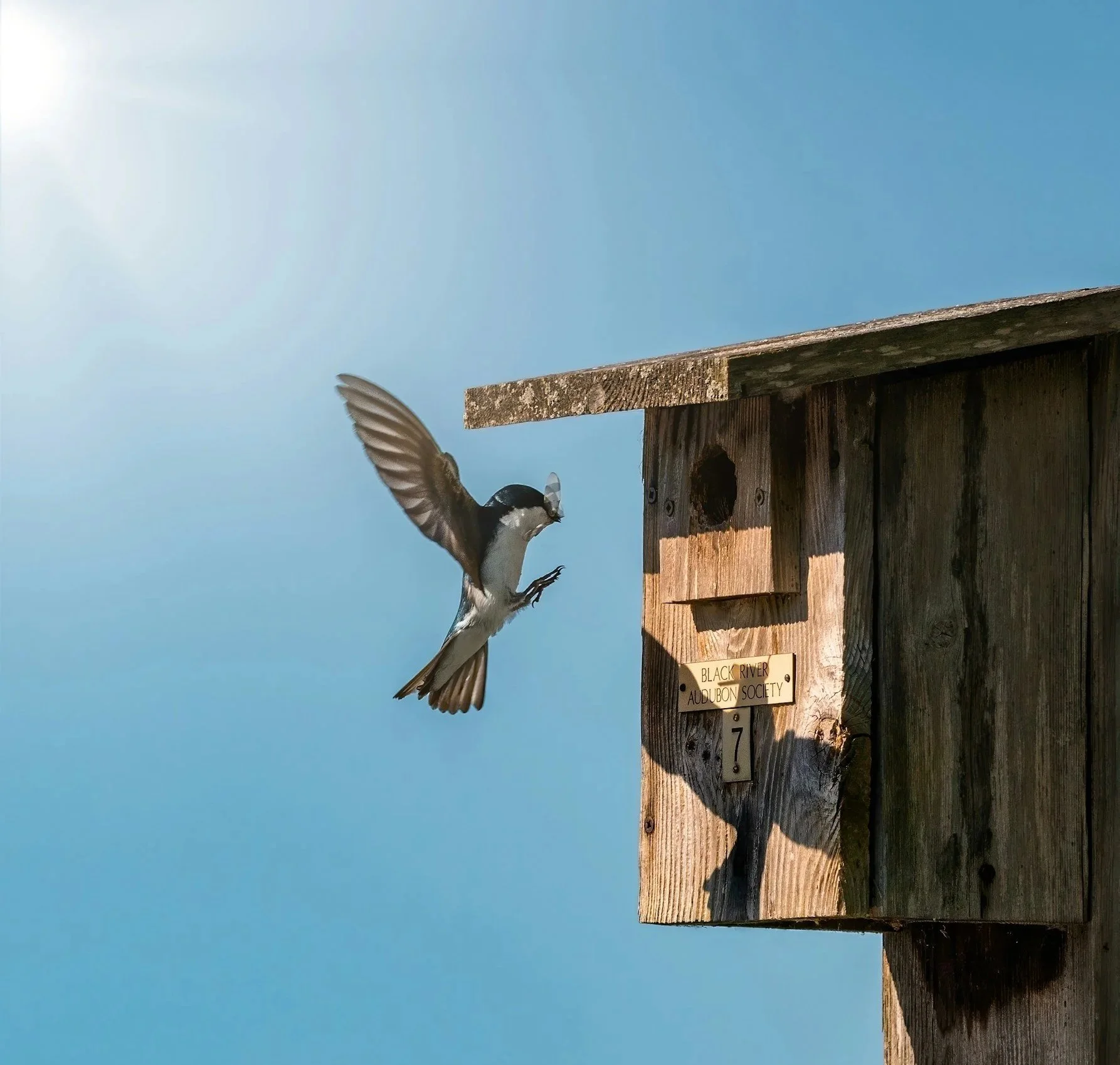
THE NEST SAFE INITIATIVE
A Laurel Field Habitat Stewardship Program
Across Washington County, Native wildlife is losing habitat at a steady and accelerating pace. Forest fragmentation, development pressure, and simplified landscapes are quietly stripping the land of the structures it once relied on.
Cavity-nesting birds and bats are among the most affected. Many depend on old trees, standing snags, hedgerows, and intact riparian corridors — features that once occurred naturally across working landscapes, but are now increasingly rare in both urban and rural settings. As these elements disappear, wildlife is left with fewer places to nest, shelter, and persist year after year.
This loss doesn’t happen all at once. It happens incrementally: one tree removed, one stream corridor simplified, one yard stripped of cover. Over time, those small decisions accumulate, reshaping entire ecosystems and breaking the processes that once held them together.
This is the context in which our work exists.
Our work focuses on long-term function. Fewer inputs. Fewer failures. Systems that strengthen year after year. Landscapes that make ecological sense, support biodiversity, and hold up under real conditions.
But planting alone isn’t always enough.
As natural nesting and roosting structures continue to disappear from the landscape, restoring plant communities must be paired with restoring function — including safe places for wildlife to raise young and shelter. That connection between land, structure, and species is where the next step of our work begins.
From that understanding, Nest Safe Initiative was created.
The Nest Safe Initiative pairs donated, site-appropriate nesting and roosting structures with active, year-long monitoring. Each installation site is supported by a participating steward — a landowner or community partner who agrees to observe, document, and report wildlife use over time. These monitoring partners are a vital part of the program, helping ensure structures are successful and contributing real, place-based insight into how wildlife is responding to restored habitat.
Each Nest Safe installation includes:
A nesting or roosting structure designed for native cavity-nesting birds or bats
Professional placement and installation, guided by habitat conditions, spacing, and established best practices
Predator deterrence measures, such as guards or placement strategies, are used where appropriate to reduce nest predation and increase success
Structures built to support long-term use, not short-term occupancy
Inclusion in a simple, year-long monitoring effort to better understand wildlife use over time
Outlined below is the total number of nesting and roosting installations available for the 2026 season.
Chickadees and Titmice3 Nest Boxes ea.
Eastern Bluebird5 Nest Boxes
Great Crested Flycatcher3 Nest Boxes
Hooded Merganser3 Nest Boxes
American Kestrel3 Nest Boxes
Nuthatches3 Nest Boxes
Screech Owl3 Nest Boxes
Tree Swallow5 Nest Boxes
Wood Duck3 Nest Boxes
Wrens3 Nest Boxes
Important Notes
Species selection and placement are determined by habitat conditions, spacing requirements, seasonal timing, and best practices
This program is designed for homeowners, land managers, and organizations looking to actively support native wildlife—not just put up a box and hope for the best.
Not all species are appropriate for every site
Invasive species, including House Sparrows and European Starlings, are intentionally excluded
Once the annual limit is reached, participation for the 2026 season will close.
Become a Monitoring & Stewardship Partner
How It Works
-
You will begin by submitting the short form below describing the site, location, and general habitat conditions. This allows us to understand whether the property may be suitable for a nesting or roosting installation.
-
We will review the submitted information to determine habitat suitability, spacing requirements, and whether the site aligns with the best practices for the species supported through the program.
-
From the eligible submissions, we select a limited number of sites for the season based on ecological value, geographic balance, and available capacity. Selected participants are contacted to coordinate timing and access.
-
The appropriate nesting or roosting structure will then be selected based on site conditions and target species. All structures are built to species-specific dimensions and prepared for long-term use before installation.
-
We will handle the installation of the structure using proper placement, mounting methods, and predator deterrence measures where appropriate. Installations are timed to avoid disturbance during active nesting periods.
-
Participants will take part in a simple, year-long monitoring effort involving periodic visual observations. Monitoring is non-intrusive and designed to help track wildlife use while supporting responsible long-term stewardship.