
Narrowleaf mountain mint shows up in open, dry ground across Washington County, especially in fields, roadsides, and sandy or rocky soils where water doesn’t stick around long.
You’ll find it in well-drained areas that get full sun, often in places that bake out during summer. It handles those conditions without much input and holds steady where more moisture-loving plants fall off.
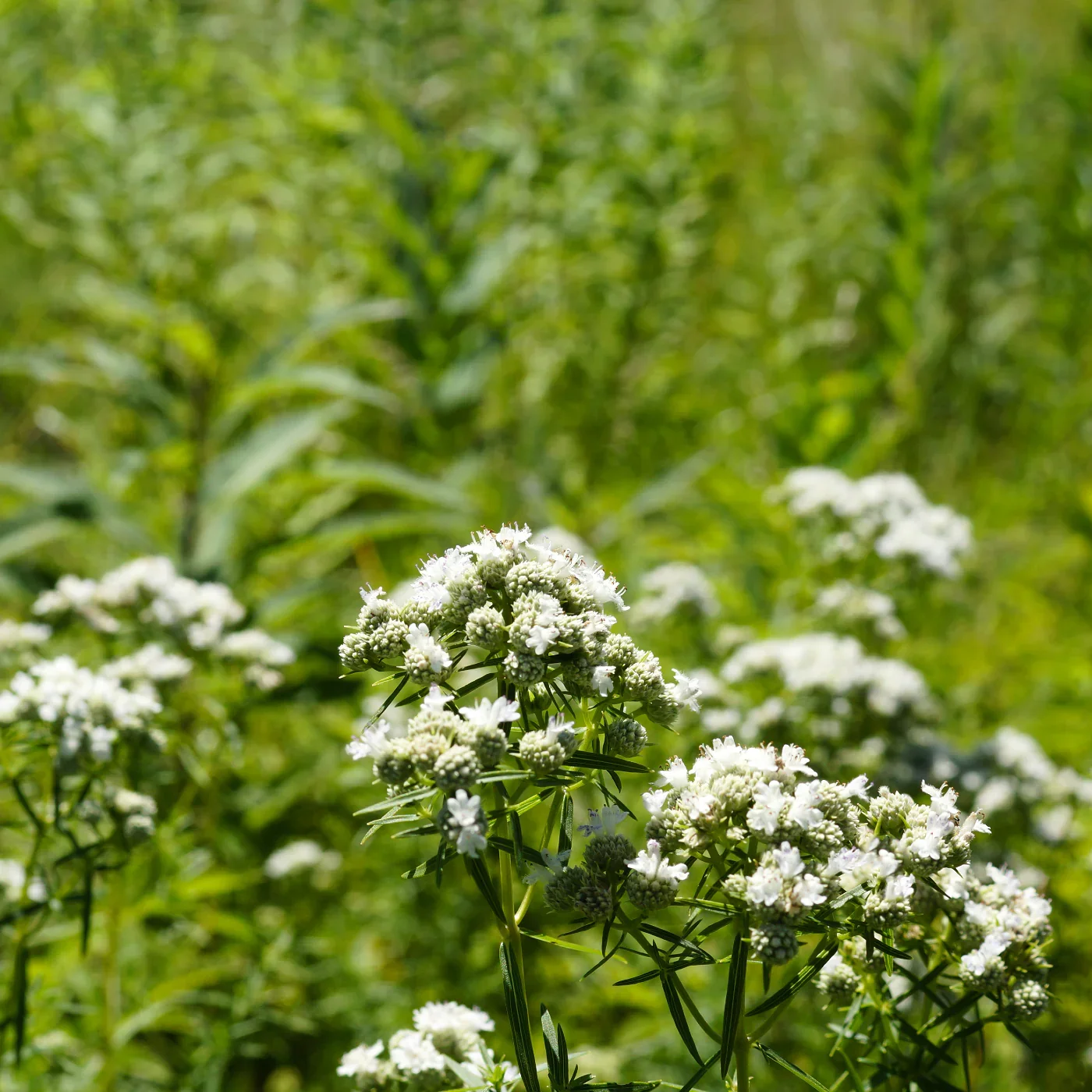
The foliage is fine and narrow, giving it a lighter, more airy look than other mountain mints. By mid to late summer, it puts out small white flowers that don’t look like much from a distance but are constantly covered in pollinators.
It usually stays around 2–3 feet tall and spreads by underground stems, forming loose patches over time. It’s not aggressive, but it will fill in open ground if conditions are right.
This is a strong choice for dry meadows, slopes, and open plantings where you want something that supports pollinators without needing rich soil or regular watering.
Light: Full sun to part sun
Soil: Dry to medium; well-drained, often sandy or rocky soils
Height: 1–3 ft
Bloom: Mid to late summer
Wildlife: Extremely high pollinator value (bees, wasps, butterflies)
Growth: Spreading perennial; forms loose colonies over time
Narrowleaf mountain mint shows up in open, dry ground across Washington County, especially in fields, roadsides, and sandy or rocky soils where water doesn’t stick around long.
You’ll find it in well-drained areas that get full sun, often in places that bake out during summer. It handles those conditions without much input and holds steady where more moisture-loving plants fall off.
The foliage is fine and narrow, giving it a lighter, more airy look than other mountain mints. By mid to late summer, it puts out small white flowers that don’t look like much from a distance but are constantly covered in pollinators.
It usually stays around 2–3 feet tall and spreads by underground stems, forming loose patches over time. It’s not aggressive, but it will fill in open ground if conditions are right.
This is a strong choice for dry meadows, slopes, and open plantings where you want something that supports pollinators without needing rich soil or regular watering.
Light: Full sun to part sun
Soil: Dry to medium; well-drained, often sandy or rocky soils
Height: 1–3 ft
Bloom: Mid to late summer
Wildlife: Extremely high pollinator value (bees, wasps, butterflies)
Growth: Spreading perennial; forms loose colonies over time