
Common ninebark shows up along streambanks, woodland edges, thickets, and open slopes throughout Washington County. It’s a highly adaptable native shrub that grows in a wide range of conditions, from moist bottomlands to drier upland sites.
You'll often find it in areas with full sun to partial shade, growing in everything from rocky limestone soils to richer woodland soils. Once established, it handles drought, heat, and occasional flooding with little trouble.
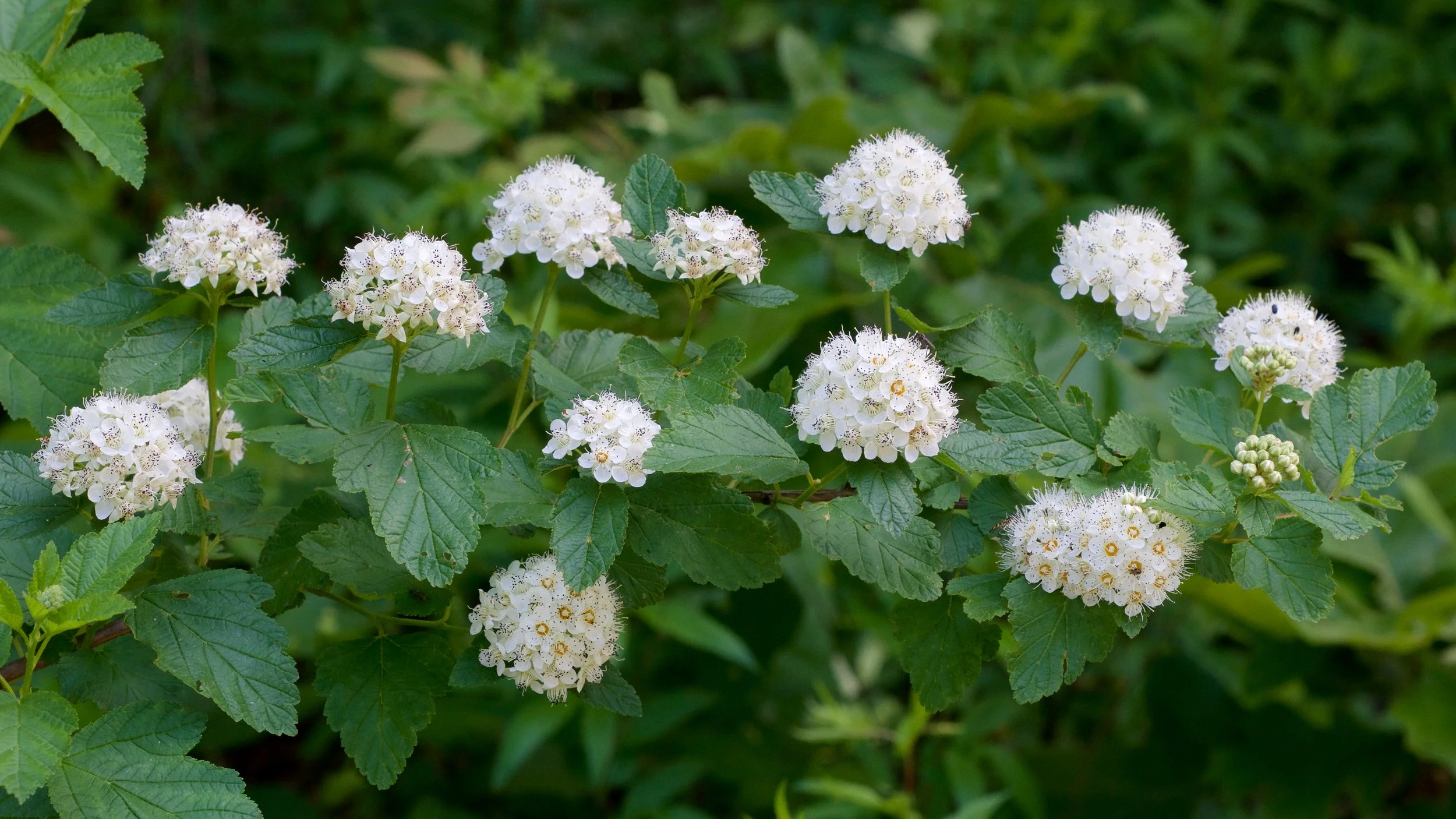
The shrub develops arching branches and dense growth, typically reaching 5–10 feet tall and wide. In late spring, clusters of small white to pale pink flowers cover the branches, attracting a variety of pollinators. As the season progresses, the flowers give way to clusters of seed capsules that provide additional visual interest.
One of its most distinctive features is its peeling bark, which sheds in thin layers and gives the plant year-round character, especially during winter. The dense branching also provides excellent cover and nesting habitat for birds and other wildlife.
It responds well to pruning but generally maintains an attractive natural form on its own. Its adaptability makes it useful in both formal landscapes and naturalized plantings.
This is a dependable shrub for hedgerows, wildlife plantings, stream buffers, and native landscapes where you want structure, seasonal interest, and habitat value without a lot of maintenance.
Light: Full sun to part shade
Soil: Dry to moist; adaptable to rocky, clay, and limestone soils
Height: 5–10 ft
Bloom: Late spring to early summer
Wildlife: Native bees, butterflies, birds, and other wildlife
Growth: Multi-stemmed deciduous shrub; moderately fast-growing, forms dense thickets over time
Common ninebark shows up along streambanks, woodland edges, thickets, and open slopes throughout Washington County. It’s a highly adaptable native shrub that grows in a wide range of conditions, from moist bottomlands to drier upland sites.
You'll often find it in areas with full sun to partial shade, growing in everything from rocky limestone soils to richer woodland soils. Once established, it handles drought, heat, and occasional flooding with little trouble.
The shrub develops arching branches and dense growth, typically reaching 5–10 feet tall and wide. In late spring, clusters of small white to pale pink flowers cover the branches, attracting a variety of pollinators. As the season progresses, the flowers give way to clusters of seed capsules that provide additional visual interest.
One of its most distinctive features is its peeling bark, which sheds in thin layers and gives the plant year-round character, especially during winter. The dense branching also provides excellent cover and nesting habitat for birds and other wildlife.
It responds well to pruning but generally maintains an attractive natural form on its own. Its adaptability makes it useful in both formal landscapes and naturalized plantings.
This is a dependable shrub for hedgerows, wildlife plantings, stream buffers, and native landscapes where you want structure, seasonal interest, and habitat value without a lot of maintenance.
Light: Full sun to part shade
Soil: Dry to moist; adaptable to rocky, clay, and limestone soils
Height: 5–10 ft
Bloom: Late spring to early summer
Wildlife: Native bees, butterflies, birds, and other wildlife
Growth: Multi-stemmed deciduous shrub; moderately fast-growing, forms dense thickets over time