
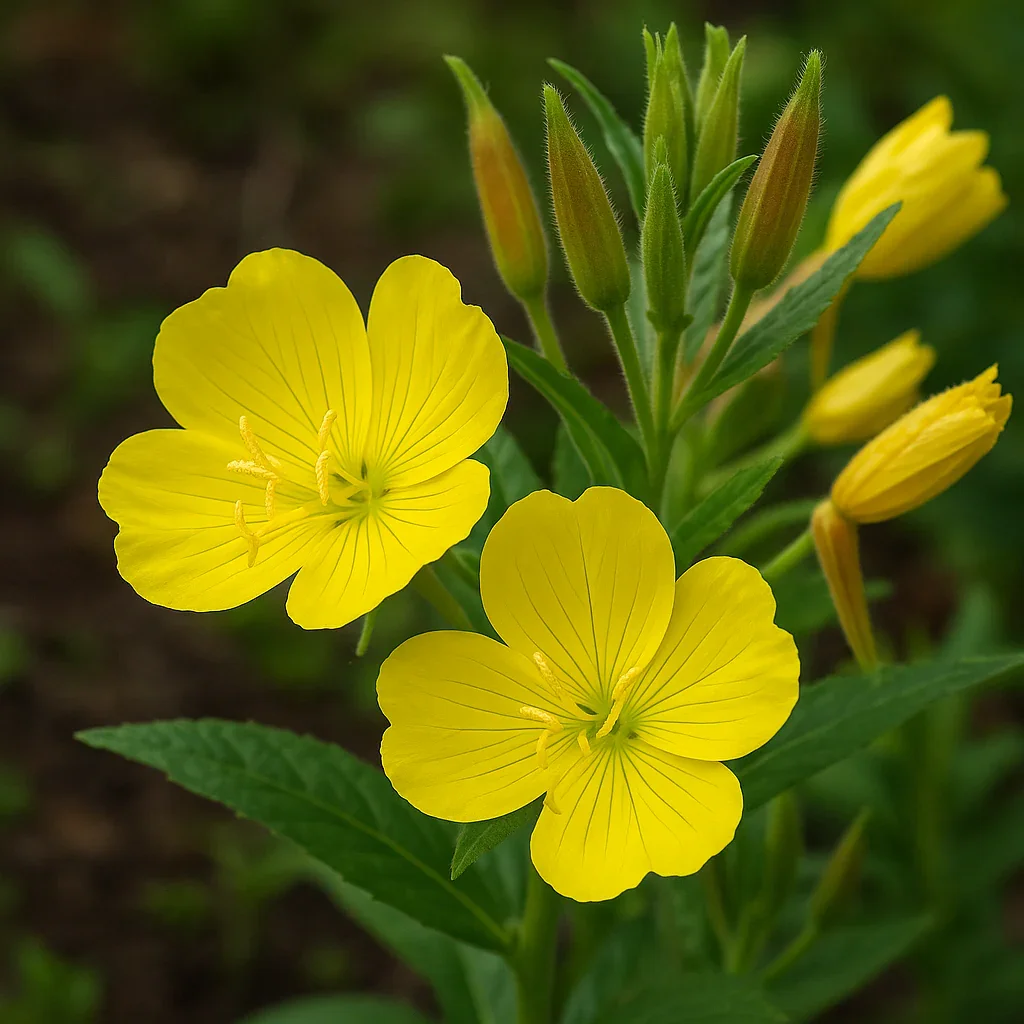
Evening primrose is one you’ll run into pretty often around Washington County, but almost always in disturbed ground. Road edges, old fields, construction sites, anywhere the soil’s been opened up and competition hasn’t closed back in yet.
It does especially well in our lighter, well-drained soils, including those rocky areas where limestone is close to the surface. It doesn’t need much to get established and will usually show up on its own if the conditions are right.
What makes it stand out is how it operates. The flowers open in the evening and stay active into the night, which brings in a different group of pollinators than most daytime bloomers. You’ll get moth activity on this one, along with bees picking it up earlier in the day.
It typically grows upright, around 2–5 feet depending on conditions, with yellow flowers spaced along the stem. It’s a biennial, so the first year is just a low rosette, and the second year it bolts, flowers, sets seed, and then drops out.
This is a good fit for open plantings, early-stage restoration, and areas where you’re trying to get coverage on disturbed soil. It fills space fast but usually gives way over time as more competitive natives establish.
Light: Full sun
Soil: Dry to medium; well-drained, often disturbed soils
Height: 2–5 ft
Bloom: Summer into early fall (evening-opening flowers)
Wildlife: Moths, bees, other pollinators
Growth: Biennial; first-year rosette, second-year flowering and seed set
Evening primrose is one you’ll run into pretty often around Washington County, but almost always in disturbed ground. Road edges, old fields, construction sites, anywhere the soil’s been opened up and competition hasn’t closed back in yet.
It does especially well in our lighter, well-drained soils, including those rocky areas where limestone is close to the surface. It doesn’t need much to get established and will usually show up on its own if the conditions are right.
What makes it stand out is how it operates. The flowers open in the evening and stay active into the night, which brings in a different group of pollinators than most daytime bloomers. You’ll get moth activity on this one, along with bees picking it up earlier in the day.
It typically grows upright, around 2–5 feet depending on conditions, with yellow flowers spaced along the stem. It’s a biennial, so the first year is just a low rosette, and the second year it bolts, flowers, sets seed, and then drops out.
This is a good fit for open plantings, early-stage restoration, and areas where you’re trying to get coverage on disturbed soil. It fills space fast but usually gives way over time as more competitive natives establish.
Light: Full sun
Soil: Dry to medium; well-drained, often disturbed soils
Height: 2–5 ft
Bloom: Summer into early fall (evening-opening flowers)
Wildlife: Moths, bees, other pollinators
Growth: Biennial; first-year rosette, second-year flowering and seed set