
Dense blazing star shows up in moist prairies, meadow edges, and low ground around Washington County. It’s most common in areas where the soil holds moisture through the growing season but still drains well enough to avoid prolonged standing water.
You’ll find it in open sunny areas with medium to moist soils. It handles seasonal wet periods well but is also surprisingly tolerant of short dry spells once established.
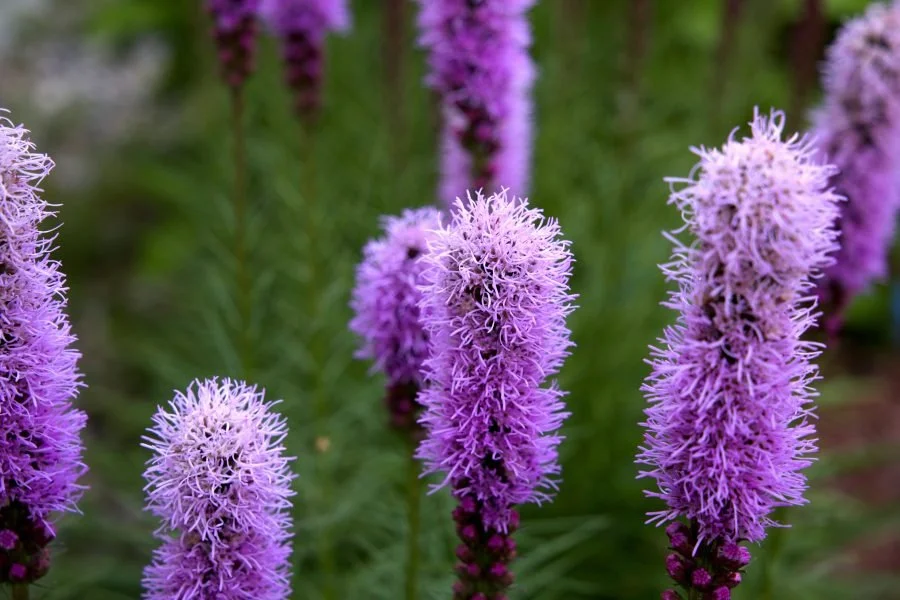
The plant grows upright with narrow, grass-like foliage and sends up tall flower spikes in mid to late summer. The bright purple blooms open from the top down, creating a distinctive display that stands out in meadows and native plantings.
It usually reaches 2–5 feet tall and stays fairly narrow, making it easy to work into mixed plantings without taking up much space. It remains well-behaved and grows in clumps rather than spreading aggressively.
The flowers attract a steady stream of pollinators, especially butterflies, native bees, and other beneficial insects. It’s often one of the busiest plants in the garden when in bloom.
This is a strong choice for rain gardens, meadows, and pollinator plantings where you want reliable summer color and vertical interest without a lot of maintenance.
Light: Full sun
Soil: Medium to moist; tolerates seasonal wetness
Height: 2–5 ft
Bloom: Mid to late summer
Wildlife: Butterflies, native bees, and other pollinators
Growth: Clump-forming perennial; slowly expanding, not aggressive
Dense blazing star shows up in moist prairies, meadow edges, and low ground around Washington County. It’s most common in areas where the soil holds moisture through the growing season but still drains well enough to avoid prolonged standing water.
You’ll find it in open sunny areas with medium to moist soils. It handles seasonal wet periods well but is also surprisingly tolerant of short dry spells once established.
The plant grows upright with narrow, grass-like foliage and sends up tall flower spikes in mid to late summer. The bright purple blooms open from the top down, creating a distinctive display that stands out in meadows and native plantings.
It usually reaches 2–5 feet tall and stays fairly narrow, making it easy to work into mixed plantings without taking up much space. It remains well-behaved and grows in clumps rather than spreading aggressively.
The flowers attract a steady stream of pollinators, especially butterflies, native bees, and other beneficial insects. It’s often one of the busiest plants in the garden when in bloom.
This is a strong choice for rain gardens, meadows, and pollinator plantings where you want reliable summer color and vertical interest without a lot of maintenance.
Light: Full sun
Soil: Medium to moist; tolerates seasonal wetness
Height: 2–5 ft
Bloom: Mid to late summer
Wildlife: Butterflies, native bees, and other pollinators
Growth: Clump-forming perennial; slowly expanding, not aggressive