
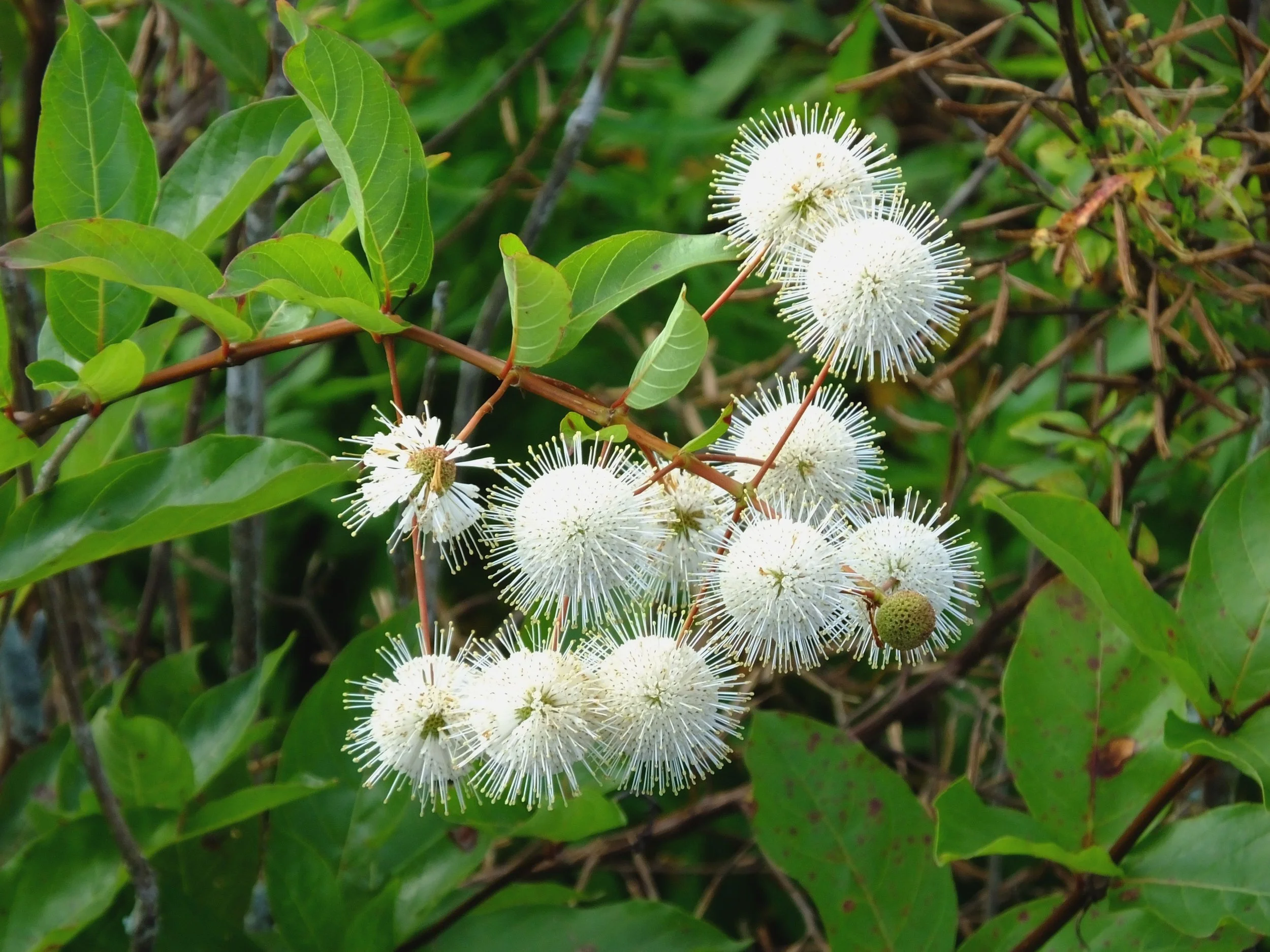
Buttonbush shows up anywhere water sticks around in Washington County. You’ll see it along ponds, slow-moving streams, floodplains, and low areas that stay wet through most of the year.
It’s built for saturated soils and does best where other shrubs struggle to survive. It can handle standing water, fluctuating water levels, and heavy soils without issue, which makes it one of the most reliable plants for true wet sites.
The flowers are round, white spheres that bloom in early to mid-summer. They stand out immediately and draw in a wide range of pollinators. It’s one of the most active shrubs you can plant in terms of insect life.
It usually grows 6–10 feet tall and wide, forming a dense, rounded shape over time. It can be pruned if needed, but it also works well left to grow naturally in larger spaces.
This is a strong choice for pond edges, rain gardens, drainage areas, and any low ground where water collects. It also helps stabilize soil along banks and edges where erosion is a concern.
Light: Full sun to part sun
Soil: Wet; tolerates saturated soils and standing water
Height: 6+ ft
Bloom: Early to mid-summer
Wildlife: High pollinator value; seeds and structure support birds
Growth: Multi-stem shrub; slowly expanding, adaptable to wet conditions
Buttonbush shows up anywhere water sticks around in Washington County. You’ll see it along ponds, slow-moving streams, floodplains, and low areas that stay wet through most of the year.
It’s built for saturated soils and does best where other shrubs struggle to survive. It can handle standing water, fluctuating water levels, and heavy soils without issue, which makes it one of the most reliable plants for true wet sites.
The flowers are round, white spheres that bloom in early to mid-summer. They stand out immediately and draw in a wide range of pollinators. It’s one of the most active shrubs you can plant in terms of insect life.
It usually grows 6–10 feet tall and wide, forming a dense, rounded shape over time. It can be pruned if needed, but it also works well left to grow naturally in larger spaces.
This is a strong choice for pond edges, rain gardens, drainage areas, and any low ground where water collects. It also helps stabilize soil along banks and edges where erosion is a concern.
Light: Full sun to part sun
Soil: Wet; tolerates saturated soils and standing water
Height: 6+ ft
Bloom: Early to mid-summer
Wildlife: High pollinator value; seeds and structure support birds
Growth: Multi-stem shrub; slowly expanding, adaptable to wet conditions